
The Sword In The Stone
The legend isn't about a king. It's about the secret of metallurgy

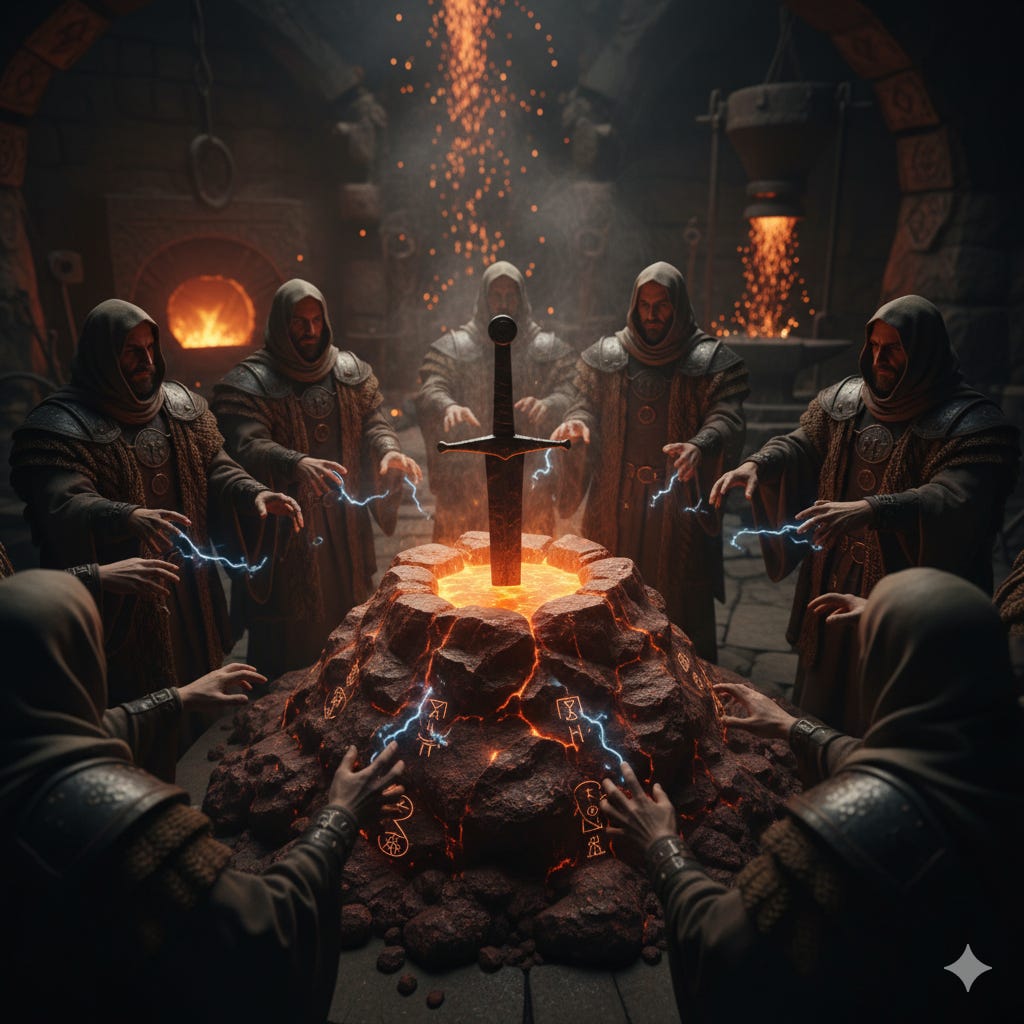
What if "The Sword in the Stone" isn't just a fairy tale. What if it’s an accurate description of the birth of a world-changing technology?
Many of us know the story: a magic sword is embedded in a stone. The strongest knights in the land try to pull it out, and they all fail. Then, a young, unknown boy named Arthur waltzes up, pulls it free, and is revealed as the true king.
It’s a great story... originally told as the Excalibur Prophecy. We treat it as a foundational myth, a simple metaphor for "true" strength being about worthiness, not just muscle.
But what if it's not a metaphor at all? What if it's... a historical report?
I have an idea that the story of the Sword in the Stone is a direct, narrative description of a technology that was poised to change the world: Metallurgy.
Magic is Just Science You Don't Understand
Think about it from the perspective of an ancient observer. They live in a world where forces are personalities. The wind is a god, the harvest is a goddess, and the world is alive with intention. Now, into this world comes a new figure. The blacksmith.
What does this person do? They go to the mountains, find a specific kind of "stone" (ore), and crush it. They build a fire hotter than any cooking fire... a roaring, dragon-like furnace. They perform rituals, use special ingredients (flux), and chant (work). Then, out of that dead, gray stone, they literally pull a shiny, "living" piece of metal.
You and I call this metallurgy... the forging of bronze, iron, and steel. But what would you call it if you had no concept of metallurgy? If you'd never seen it before.
You would call it magic. And when you tried to tell other people about it, you'd describe it in terms familiar to you. You'd have a narrative... a story for it. Like how, in the traditions of the Dogon people of Mali, the first blacksmith didn't just invent a forge... he descended from the heavens in one, his "ark" was literally his anvil. He brought this "magic" to earth by stealing embers from the sun, hidden in his bellows. The blacksmith wasn't just a person; he was a culture hero who stole fire from a god to give it to man.
We do the same thing today. I have no idea how quantum physics allows my smartphone to work. It's just "advanced science." Heck, I barely understand how a car's engine works. I can drive with expert skill, but I couldn't tell you how to build an engine... a transmission... how to put them together to make a car that runs. I leave that to a mechanic who fixes and builds them for a living. And even his knowledge is limited... the engineers and scientists who design and build electric cars and hybrid cars have an even deeper understanding. Whenever I try to communicate my understanding of these things, I use analogies... metaphors. I speak in terms of what's familiar to me. I've even jokingly said "I don't know, the science is too much for me, it just works like magic".
And to our ancestors, our view of "advanced science" and their view of "magic" are functionally identical. Their magic was their science. They are both labels for esoteric knowledge that grants real-world power.
A World Forged in Fear
This new "magic" of forging metal wasn't just a party trick; it was a social catastrophe. It broke the world. A man with a copper or bronze sword could defeat any warrior with a stone axe. His son's newer iron sword could cut through the old timer's copper and bronze weapons like they were butter. And eventually, a man with a steel sword would defeat his iron sword in this arms race. This created a new, terrifying basis for power.
How does a society cope with this? It creates narratives to understand it. And if you look, this narrative, this myth describing the "magic," it's everywhere.
In Greek myth, Hephaestus is the god of the forge. He's so vital he builds all the gods' weapons, but so "unnatural" and dangerous that he is the only ugly, lame god, cast out of Olympus. This isn't just a Greek idea. In the Hindu Vedas, the divine craftsman Vishvakarma is the architect of the universe who forges the Vajra, the indestructible thunderbolt for Indra, the king of the gods. In both myths, the message is identical: the ruling class is completely dependent on its blacksmiths for survival.
In Norse myth, Wayland the Smith is a divine artisan. A jealous king captures him and cuts his tendons (laming him, just like Hephaestus) to control his talent and enslave the "means of production." This fear of the smith as a volatile force is even more explicit in West Africa. The Yoruba god of iron, Ogun, is both revered and feared. He is a "hot," dangerous deity, the creator and the destroyer... the god of the surgeon's scalpel and the warrior's sword, the force that can build civilization or tear it apart.
Sometimes, this tension explodes. The Persian Shahnameh, a foundational story in Iran, Pakistan, and parts of India, tells of Kaveh the Blacksmith. He's a mortal artisan whose sons were murdered by a tyrant. In a rage, Kaveh takes his own leather blacksmith's apron, hangs it on a spear, and uses it as a revolutionary banner to overthrow the king.
These myths all encode a deep societal fear: we need this new technology, but we distrust the man who wields it. The old-world king must control this technology to keep his power.
The New Contract: A King in the Forge
The "Sword in the Stone" narrative is another solution to this problem. In this new myth, the king doesn't imprison the smith... he becomes the smith.
Arthur, a boy with no known lineage, proves his worthiness not by his blood, but by his action. He is the only one who can perform the "magic" of extracting the metal from the stone. He is the one who has mastered the new power. The process of extracting iron and steel from the rocks, the ore, that contain it.
And this new story becomes the prototype for a new social contract
The story of Arthur isn't just about a magic sword. It's the story of a new political order. This idea... that the mastery of metallurgy is the new, tangible "right to rule"... is the real magic. And again, this "description of the new technology", this mythological narrative, shows up all over the world.
In ancient China, the sage-king Yu the Great forged the Nine Tripod Cauldrons from bronze collected from all nine provinces. For centuries, possessing these specific metal objects was the "Mandate of Heaven." Their ownership was the physical symbol of legitimate rule.
In Japan, the divine sword Kusanagi-no-Tsurugi... pulled from the tail of a chaotic eight-headed serpent, much like a sword from a stone... is one of the Three Imperial Regalia, the literal proof of an emperor's divinity and right to the throne.
The Sword in the Stone narrative is Europe's version of this social contract. The old world of "birthright" is dead. The new world is here, and it will be led by the one who has mastered the technology that defines the new age.
This pattern of myth-making never stopped. As we moved from the Iron Age to the Scientific Revolution, the myth just changed clothes. The "magic blacksmith" was no longer a smith, but a scientist.
The new archetype became Dr. Frankenstein, an artisan working not with a forge, but a laboratory. The new "magic" wasn't metallurgy, but electricity. And the "monster" he pulled from the slab was the same old story: the terrifying, awe-inspiring, and society-breaking power of a technology we had unleashed, but were not sure we could control. Frankenstein's monster.
And today the narrative of uncontrolled power, of unimaginable threat, has changed clothes again. A new world is here, a revolution in progress, and it will be led by the ones who have mastered the technology that defines the new age.
It's the same old story: the terrifying, awe-inspiring, and society-breaking power of a technology we have unleashed, but we're not sure we can control. Frankenstein's monster is back, as he warned us he'd be back. He's dressed in black leather and wears sunglasses... he's the Terminator.
The terrifying, awe-inspiring, and society-breaking power of a technology we have unleashed, but we're not sure we can control is AI... Artificial Intelligence.
And if the future gets the chance to look back, they'll see our narrative as it's being written right now. They'll see this next generation of myth building... our narrative describing our fears, our hopes, and our dreams. If...
Thank you so much! It's one of my favorite things to read about and we're learning so much these days that's fitting together like pieces of the big puzzle. Literally, I like to assemble pieces I discover from here and there... there's a constellation of facts that makeup that big picture. When you've got a lot of the context like we do now... the data from ancient dna analysis and latest archeological findings, it puts that new perspective together.
You reread the old cultural stories and a connection becomes clear. And the religious writings around the world have so much to re-teach people. There's a real world underneath everything... a real series of events happened in the past and the got encoded into language, place names in geography, religious texts, mythology.. its just fascinating to make the connections. Thanks again for the great comment!
Thanks Zahra, I totally agree... we can bypass the gatekeepers of knowledge and see for ourselves