
The Patteran
Silent secrets of the Romany road. A hidden language in leaves and stones

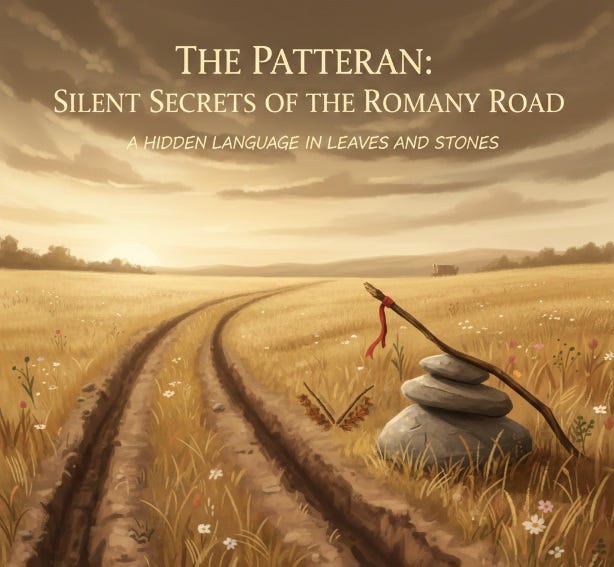
In the modern world, we navigate by satellites. A blue dot pulses on a glass screen, telling us to turn left in 200 yards. But for centuries, another kind of navigation existed. One that didn’t require a signal, only a keen eye and a deep understanding of the natural world.
It was called the Patteran (or Patrin). To the uninitiated “Gorgio” (non-Romany) traveler, it looked like a pile of rocks, a stray branch or a handful of discarded grass. But to the Romany families traveling the roads of Europe and the UK, it was a silent telegraph. A survival manual etched into the dust.
The Leaf and the Pattern
There is a common misconception that the word patteran is simply a Romany corruption of the English word pattern. While they share a poetic resonance, their histories are worlds apart.
“Pattern” comes from the Latin patronus, meaning a model or protector. But patteran traces its lineage back to the Sanskrit pattra, meaning leaf. It is a literal description of the medium: the earliest signs were made of leaves and twigs. While the “Gorgio” world looked for stone monuments, the Romany people found their way through the ephemeral.
The Grammar of the Road
The patteran was not a static symbol; it was a flexible language. If a lead wagon (vardo) reached a fork in the road, the driver would leave a sign for those following hours or even days behind.
The V-Shape: Two twigs laid in a “V” pointed the direction of travel.
The Cleft Stick: A stick jammed into a hedge with a branch pointing like an arrow was a “high-visibility” marker for dusk.
The Grass Trail: Handfuls of grass dropped at intervals acted as a breadcrumb trail. If the grass was tied in a knot, it signaled a “hurry”... the lead group was moving fast and the followers needed to catch up.
Protection: Beyond the Physical
The road was not always friendly. In the 19th century, when folklorists like George Borrow and Charles Leland began documenting these signs, they discovered that the patteran was also used for “conduction”... guiding the community safely through hostile territory.
Protective markings were often left on gateposts or fences to warn of what lay ahead:
The Warning: Jagged lines or parallel scratches warned of a biting dog or an aggressive landowner.
The Welcome: A simple cross or a circle with a dot indicated a “good house”—one where a traveler might find work, water, or a fair trade.
But protection also took a spiritual form. To ward off the Jakhendar (the Evil Eye), the Roma didn’t just rely on wood and stone; they used color and ritual. The Indralori, a red ribbon tied to a horse’s bridle or a child’s wrist, served as a “visual lightning rod,” catching and neutralizing the gaze of those who wished them ill.
The Architecture of the Vardo
If the patteran was the language of the road, the vardo (the living wagon) was the fortress. Every carving on a traditional wagon served a purpose. Horseshoes were nailed to the door to repel spirits, while intricate carvings of lions, birds, and flowers weren’t just decoration... they were symbols of vitality and strength.
Even the most famous Romany symbol, the 16-spoked Chakra (wheel), is a symbol of conduction. It represents the eternal journey, the link to the ancestral home in India, and the protective cycle of a life lived in motion.
While twigs and leaves were the most common materials for temporary directions (because they were “biodegradable” and hidden in plain sight), stone piles or cairns played a very specific role in the Romany navigation system.
The “Atchin Tan” Markers
In the Romany language, a traditional stopping place or campsite is called an atchin tan. Because these locations were used by generations of travelers, they needed a more permanent marker than a handful of grass.
Permanent Signposts: Stone piles were often used to mark the entrance to a safe atchin tan. These piles would be tucked slightly off the main road, perhaps under a specific tree or near a stream.
The Rule of Three: A common stone patteran involved three stones piled on top of each other.
If the top stone was tilted in a certain direction, it indicated where the water source was.
If a larger stone was placed at the base, it might signal how many families the site could accommodate.
Safety Status: In some regions, stones were used to communicate the safety of an area. A specific arrangement of stones could warn a family that the local “Gorgio” (non-Romany) population was hostile or that the police had recently cleared the camp
Why the Patteran Matters Today
In an age of total surveillance and digital footprints, there is something profoundly beautiful about the patteran. It was a form of communication that was entirely “offline.” It was biodegradable, leaving no trace for the authorities but remaining perfectly legible to the “traveling people.”
The patteran reminds us that “knowing the way” isn’t just about coordinates. It’s about paying attention to the small things. A broken twig, a pile of stones, a red ribbon in the wind. It’s about a community staying connected through the very earth they walk upon.
The next time you’re hiking and see a strange arrangement of stones that looks just a bit too “placed” to be accidental, take a second look. You might be standing on the site of an ancient conversation.