

We have a habit of thinking of the past as primitive. We forget how much knowledge we’ve lost from back then. Real life, everyday ways of accomplishing tasks that machines and tech do for us now.
Ever since the industrial revolution, we’ve lost a lot of skills that used to be commonplace. Like how most everyone could draw and many could paint with skill... because there were no cameras invented yet. So everyone learned drawing skills and composition skills like perspective and 3d representation, as a common everyday tool they used in their daily life. Like how now we all learn reading, writing, and math skills before we’re 10 yrs old.
There were no clocks as we typically think of them, for most of time. Not till recently. You would’ve used other skills to tell time. You would’ve used other tools to tell time. Other indicators of time passing, like the sun and the moon patterns. For more detailed attention to time within a day you would pay attention to the shadows in your yard or on a sundial, watch the sand drop in an hourglass, or burn a candle or an incense stick and watch its progress to know the time.
Or you might just watch water drip from one container to another, or you might sing a song. Or, you might listen for church bells, the birds at the precise coming of dawn, the rooster crow, or you might wait for the wild turkeys to shoot up into the trees like they do... like clockwork at dusk
Its really fascinating to observe the traditional methods preserved by skilled laborers in various countries... the tools, skills, and knowledge forgotten where technology and convenience has replaced them... erased them.
And some of the old ways are coming back. Re-discovered... re-invented.
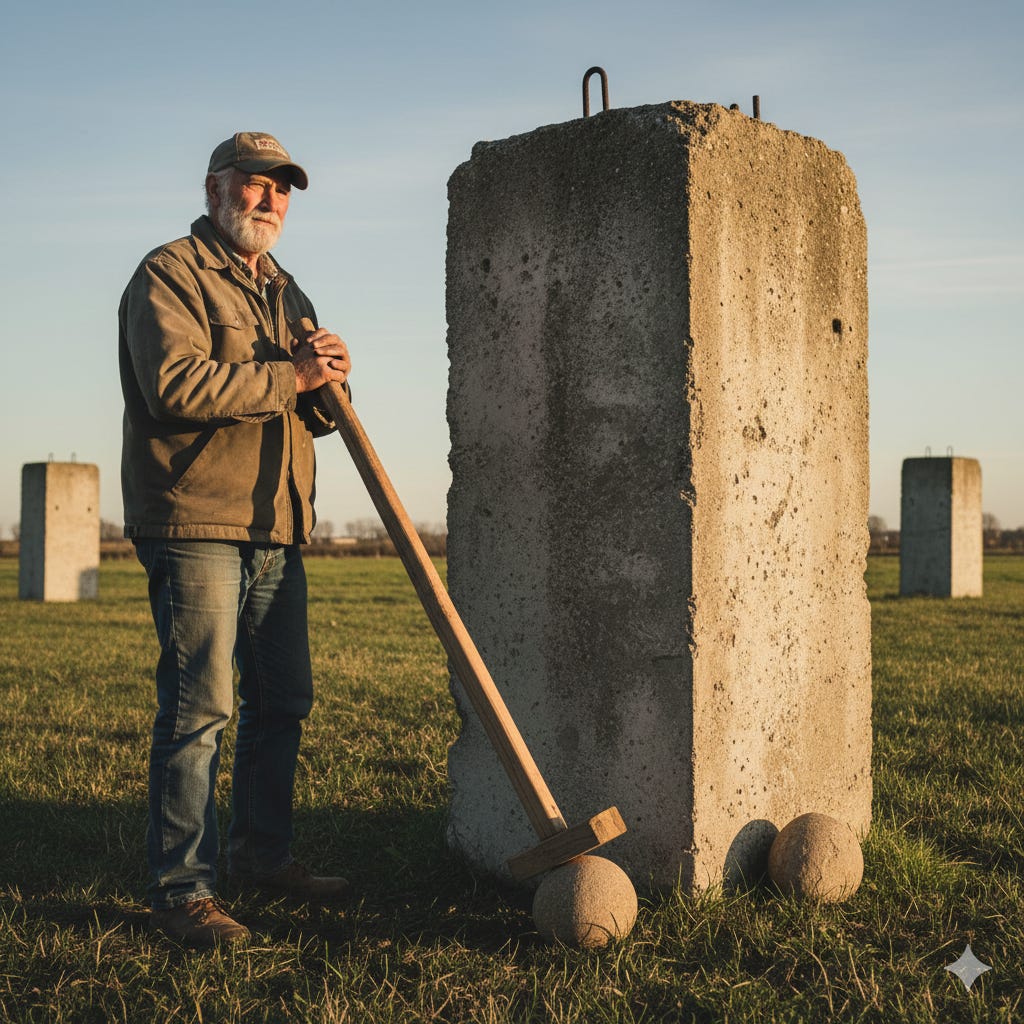
There’s a guy named Wally Wallington, from Lapeer County, Michigan, here in the U.S. Wally is a retired building contractor who worked with very large blocks of stone and concrete. Through his practical need to do his everyday job, he developed the techniques to easily move monumental blocks of stone or concrete across a field... by himself. He shows you on video how he does it. No ancient aliens required.
Not to say there weren’t any ancient aliens... they’re just not necessary to do Wally’s job. Wally can show you how to do it. He can erect obelisks upright in the sand, pile massive blocks of stone on top of each other... all by himself... on camera. No illusions, no magic, just ancient principles we call physics, force, momentum, balance, pivot, levers, pulleys, and handles.
Using his methods he’s refined... on the job... he literally can put a handle on a barn and walk that barn to another place on his property... by himself. I shit you not.
Wally gained attention for his ability to move massive, multi-ton concrete and stone blocks by himself, using only simple tools and his understanding of physics.
He proposes that his methods could explain how ancient civilizations, like those that built Stonehenge or the Egyptian pyramids, moved their giant stones without modern machinery.
Stonehenge Replica
Wally is most famous for constructing a “Stonehenge-like” structure in his backyard using massive concrete blocks, and for moving that barn... an entire pole barn... across his property. He has demonstrated his ability to “walk” an entire pole barn across his property, by himself.
That’s not all
Wally’s shown he can single-handedly lift and stand upright concrete blocks weighing nearly 20,000 pounds. All on video.
His Technique
Wally Wallington’s method doesn’t rely on modern, powered equipment. Instead, he uses basic principles of physics, mechanics and simple machines.
Levers & Pivots
He uses a beam lever and small stones as pivots. By placing a pivot point near the block’s center of mass, he can balance the massive object.
“Walking” Blocks
By rocking the block back and forth on the pivots and incrementally moving them, he can effectively “walk” a block forward. He has demonstrated moving a one-ton block at a rate of around 300 feet per hour by himself.
Counterweights
For lifting, he uses a system of counterweights and pivots to gradually and safely raise massive blocks into a vertical position.
He has been featured on YouTube and on television programs, including the Discovery Channel, to demonstrate his techniques. This guy is for real. And his methods work.
Wally Wallington’s work is fascinating because it’s a practical demonstration of “experimental archaeology,” even if he’s not a formal academic. He’s essentially testing a hypothesis with his own hands.
His methods are all about converting a small, continuous force (his own) into the movement of a massive object by applying it intelligently.
”Walking” Blocks (Horizontal)
This is his most famous technique. It’s not just dragging.
He uses a wooden lever to lift one edge of the block just enough to slide a small stone pivot underneath, near its center of gravity. Then he rocks the block on this single pivot, and it’s balanced, like a seesaw.
He places a second pivot stone under one end.
He then rotates the block around the first, central pivot. The end of the block, which is on the second pivot, rolls forward...
He repeats this process, swiveling the block back and forth on its pivots, making it “walk” forward in a rotating motion. He can move a 1-ton block about 300 feet per hour this way.
Lifting Blocks Vertical
Ratcheting Up...
To get a block off the ground, he’ll rock it from side to side, adding a small piece of wood or a stone under the lifted edge each time. This “ratchets” the block higher and higher off the ground.
Counterweight System
To stand a block on its end (like a 20,000 lb. monolith), he uses a clever counterweight system. He builds a wooden frame (like a seesaw with the block on one end) and adds smaller, manageable stones to a bucket or platform on the other end.
By slowly adding more and more counterweight, he gradually and safely lifts the massive block into a vertical position, at which point he can tip it into a pre-dug hole.
The Origin of His Theory
This project didn’t start as an attempt to solve ancient mysteries. It began as a practical problem on a construction job.
He was tasked with removing 1,200-pound concrete blocks from an existing floor, but he couldn’t get machinery into the area. The standard method would be to break them up with sledgehammers, a slow and labor-intensive process.
Wallington decided to experiment and figured out his “walking” pivot technique to move the blocks whole to a location where a machine could reach them. He was struck by how simple and effective it was, which led him to wonder if ancient people had discovered the same principles.
Public and Expert Reception
Wallington’s work exists mostly outside of mainstream academic archaeology, but this gatekeeping hasn’t stopped his huge following online. The public is fascinated with his methods, his results. And academia is slowly turning its attention toward Wally. Recently, archeologists walked replica Easter Island monoliths around using variations on his techniques, providing more proof of concept.
To the general public, his work is incredibly popular. It’s a simple, visual, and common-sense solution to a puzzle that is often over-complicated by theories of “lost high technology” or aliens.
The idea that one clever person with rocks and sticks could do it is very appealing. And makes common sense. Because its not just a theory to be tested. Not just a topic to be debated. Wally had on the job experience... in real life... with real stone blocks that actually needed to be moved. It’s not his backyard hobby. Not his pet theory. Not his endless speculation. It’s his job. And yet...
The academic View...
While archaeologists and engineers respect the ingenuity, they don’t necessarily accept it as the definitive answer. They prefer to continue the debate, continue the speculation, continue standing at the gate of knowledge, deciding who walks through. Their main arguments are:
Scale
Wally Wallington moves one block at a time. Ancient sites moved thousands of blocks, often over great distances and up steep inclines (like the Great Pyramid). This is a problem for the academics.
What does Wally say? What does Wally do... He doesnt debate... he wouldnt just speculate. Wally would just post on Indeed, and hire some help.
They need even more Evidence
While his method is plausible, there isn’t always direct archaeological evidence (like preserved pivots or levers) to prove this specific technique was used over others (like using wooden sledges on wet sand, for which there is evidence in Egypt).
Wally has a toolbox with other tools. Common sense tells us he does... tells us he’d set down his lever and grab the right tool for the job... the situation... the environment.
Manpower
Most experts agree that while one person can do this, ancient projects had massive, organized labor forces and likely would have used less precise but much faster methods. They have yet to identify these “faster methods”. And like we already figured out, Wally can post on Indeed if he needs more help.
Current Status of His Project
Wally has not been active publicly for several years. His grandson has started a new YouTube channel to re-upload and share his grandfather’s original videos and knowledge, which has renewed interest in his work.
Wally moved his entire project... including the multi-ton blocks, to a new home 10 miles away. Another feat that demonstrated his techniques.
Wally Wallington is a “hands-on” theorist who proved what is possible for a single person to achieve using simple, clever solutions that our ancestors might have used.
Here’s a link to his YouTube videos, you’ll really like them. They are not AI, they’re for real.
(Source: YouTube share.google/5LGLs5Tkws…)
Hey, great read as always. It's funny to think what basic skills we trade for algorithms. What do you think we're losing now? Realy insightful!